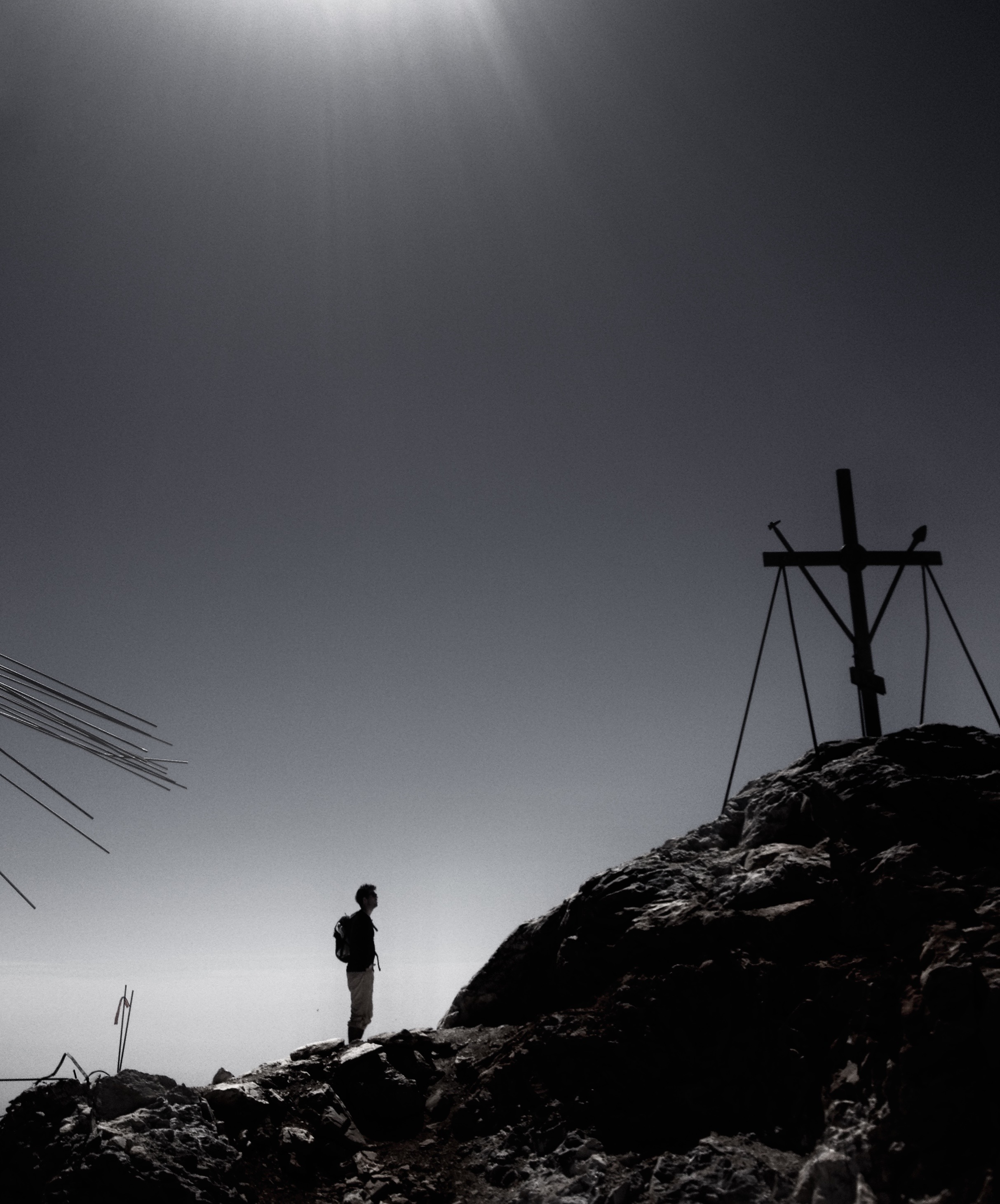
Then God said, ‘Let Us make man in Our image, according to Our likeness’.
The Book of Genesis
Christ—The Image of God
The Orthodox understanding of human nature is based primarily on verses from Genesis: “Then God said, ‘Let Us make man in Our image (κατ’ εἰκόνα), according to Our likeness’ … So God created man in His own image, in the image of God He created him.”1 Man is created according to the ‘image’ (ἡ εἰκών) of God.2
In the New Testament, the same Greek word for ‘image’ (ἡ εἰκών) is used in relation to Christ. Christ Himself is the image of God, as St. Paul teaches in his Epistle to the Colossians: “He is the image of the invisible God.”3
While we are created in the image, or according to the image of God, Christ is the image, that is to say, the identical or natural image of God. There is a fundamental difference. Technically speaking, Christ is the image of God, while man is created according to the image of God, or precisely, according to the image of Christ.
St. John Damascene writes: “There are different kinds of images. First there is the natural image. … The Son is the natural image of the Father, precisely similar to the Father in every way, except that He is begotten by the Father … Therefore the first kind of image is the natural image. … [Another] kind of image is made by God as an imitation of Himself: namely, man.”4
Christ is the natural image of God, while man is created according to this image: “The distinction is clear that Christ constitutes the image of God and man the image of Christ; that is to say, that man is the image of the Image.”5 The Orthodox understanding of human nature is focused on the Person of Christ.
Christ is the model or ‘Archetype’ on which Adam is created. Referring to Christ as the ‘new man’ or the ‘new Adam’, St. Nicholas Cabasilas explains, “It was for the new man [Christ] that human nature was created at the beginning … He Himself is the Archetype for those who are created. It was not the old Adam who was the model for the new, but the new Adam [Christ] for the old … For those who have known him first, the old Adam is the archetype because of our fallen nature. …
“But for Him who sees all things before they exist, the first Adam is the imitation of the second [Christ]. It was in accordance with His pattern and image that he [Adam] was formed.”6
Human nature was not created for man alone. From its origin, human nature was created for the Incarnation. Human nature was created to be assumed by the Person of the Son of God.
Our dignity as human beings is based on Christ, Who is simultaneously the model on which we are created, and the ultimate goal toward which we naturally tend.7 This teaching that human nature is created for the sake of the Incarnation of Christ is found in other patristic writings.8
St. Gregory Palamas writes: “God adorned human nature in this way because He was going to clothe Himself in it. He was to assume it from the blood of the Virgin, transform it into something better, and set it on high above all principality and power …”9
St. Nicholas Cabasilas adds: “For God did not create humanity with one purpose in mind only to decide later on to use it for a different purpose … He created mankind with this end in view, that, when He needed to be born, He might take from it a Mother. Having first established this need as a kind of standard, He then fashioned man in accordance with it.”10
St. Maximos also teaches: “This [the Incarnation] is the blessed end for which all things were created. This is the preordained divine goal of the origin of beings, which we define as the preordained end for the sake of which all things exist. … It was with a view to this end [the Incarnation of Christ] that God brought forth the essence of all beings.”11
St. Nicodemos of the Holy Mountain elaborates further: “Do you see that God made man in His own image for this reason, that man might be able to accommodate the Archetype through the Incarnation? Therefore, God created man as a link between the intelligible and the sensible worlds and as a recapitulation and summary of all creatures for this purpose, that by being united with man He might be united with all creatures, and that everything in heaven and on earth might be recapitulated in Christ … that Creator and creation might be one.”12
He summarizes, “From what has been said, then, anyone can conclude that unquestionably the mystery of the Incarnation had to take place, for the chief and supreme and essential reason that this mystery was the preordained will of God …”13
According to these Fathers, human nature is created to be united to God in Christ.
This is a primary distinction: the distinction between Christ Who is the direct, identical or natural image of God; and man, who is created according to, or in, the image of Christ.14
There is, however, another important distinction also fundamental to the Orthodox understanding of human nature.
The Distinction Between Image and Likeness
The precise meaning of the phrase ‘in the image and likeness’ has occupied the minds of many throughout the history of the Church. In the original Hebrew, the words ‘image’ and ‘likeness’ are essentially synonymous.15 For the Church Fathers, however, image and likeness have a distinct meaning.
The image is that which is given to us at the moment of our creation. It is the common property of all human beings.16 Likeness to God, however, is something we must struggle to attain. Image is the innate potential within man for attaining Christ-likeness, while likeness refers to its achievement or realization. Attaining to this likeness of Christ is the ultimate purpose of life, the fundamental goal of human existence.
Metropolitan Kallistos (Ware) describes the distinction between image and likeness: “The image is the initial endowment conferred on man at creation, the likeness is his final aim to be attained through the correct exercise of human freedom, aided always by God’s grace. Image is to likeness as potentiality to realization, or as starting-point to end-point. The image is not self-sufficient but forward-looking, directed always to its fulfillment in the likeness. “Man … is throughout his life on a journey from the image to the likeness.”17
The image is our innate potential given by God to become like Him. Likeness is actually achieving that potential.
Elder Sophrony refers to this same distinction, “When it is God’s good pleasure to unite with the human being, man perceives within himself the action of a Divine force which transfigures him and makes him no longer just potentially godlike—in the image of God—but actually godlike in likeness of being.”18
We are not created in a state of completed perfection. We are, however, endowed with the freedom to choose, to either live in pursuit of achieving our full potential, or else to digress toward the desecration and defacement of our true dignity as an icon of Christ.
Only through the proper use of our God-given freedom can we cooperate with divine grace in restoring the image of Christ within us, and attain to likeness with Christ, for which we are created. In the Person of Christ, divine nature and human nature are forever united as one. God not only became man—man can also become divine.
Man’s spiritual perfection as he grows from the image to the likeness of God is not simply sanctification, or deification. It is Christ-ification.19 It is attaining to the likeness of Christ.
The Image of God in Human Nature
In spite that our nature is now fallen and marred by sin and separation from God, we still retain the divine image in which we are created. The image of God in fallen man is disfigured and distorted, but it has not been entirely destroyed or annihilated. Never are we totally deprived of the divine image in which we are created.20
The image of God in man is not limited to one specific quality or characteristic of human nature. Rather, it emanates as “through a prism, throughout the whole of human existence.”21
Many Orthodox writers discuss various aspects or attributes of the image of God in man. Even within the writings of one particular author, the phrase ‘in the image’ may take on a variety of connotations.22 Some definitions vary, due to the specific context the author was addressing.
“Sometimes the expression ‘in the image’ refers to man’s free will, or to his rational faculty … sometimes to the soul along with the body, sometimes to the mind … and sometimes comprehensively to the whole man.”23 For the most part, however, the divine image pertains primarily to the human soul.24
Soul
Generally speaking, in a secular sense, a soul is defined as “the principle of life, thought, or action in man or animals; the spiritual part of man in contrast to the purely physical; an entity distinct from the body; or, the seat of the emotions, feelings or sentiments; the emotional part of man’s nature.”25
This dictionary definition makes no mention, however, of our soul’s unique value, which should be a foremost consideration: “There is nothing equal in value to the soul. … the soul by itself is far more valuable than the whole world and any worldly kingdom …”26
St. Gregory Palamas emphasizes the unique abilities of the human soul, “The human soul is something great and wondrous, superior to the entire world; it overlooks the universe and has all things in its care; it is capable of knowing and receiving God, and more than anything else has the capacity of manifesting the sublime magnificence of the Master-Craftsman.”27
St. John Damascene provides a more succinct definition: “A soul is a living substance, simple and incorporeal, of its own nature invisible to bodily eyes, activating an organic body in which it is able to cause life.”28
Concerning the relationship between our soul and body, St. John Damascene also teaches, “The soul is united with the body, the entire soul with the entire body and not part for part. And it [the soul] is not contained by the body, but rather contains it, just as heat does iron …”29
Met. Hierotheos emphasizes that our soul and body come into existence together. The soul is created with the body at conception: “The embryo is endowed with a soul at conception. The soul is created at conception and the soul at that time is just as active as the flesh. As the body grows so the soul increasingly manifests its energies.”30
Furthermore, St. Gregory Palamas teaches that our soul possesses a life of its own, distinct from our body. And every human soul will continue to exist, even when the body dies and decays: “The soul has life not only as an activity but also as its essence, since it is self-existent; for it possesses a spiritual and noetic life that is evidently different from the body’s and from what is actuated by the body. Hence when the body dissolves, the human soul does not perish with it.”31
The soul of an animal, however, does not have life ‘in itself’, like a human soul does. Rather, Palamas continues, the soul of an animal has life only as ‘activity’, that is to say, only when it animates a particular physical body.
“The soul of each animal not imbued with intelligence … does not possess life as essence, but as activity … the soul of animals consists of nothing except that which is actuated by the body. Thus, when the body dissolves, the soul [of animals] inevitably dissolves as well.”32
In regard to the human soul, the Church Fathers delineate various aspects or attributes that reflect particular distinctions within it, without any sense of separation into isolated components or parts.33
These distinctions or attributes within the human soul are referred to by different names, some stemming from Greek philosophy: “St. Gregory Palamas teaches that as God is Nous, Word and Spirit, so also the soul has nous, word and spirit. … Beyond these divisions St. Gregory … also uses the division of the soul established at the time of the ancient Greek philosophers. Man’s soul is one, although it has many powers. It is divided into three parts: the intelligence, the appetitive power and the incensive power.”34
Among the various faculties or functions of the human soul referred to by the Church Fathers, we will focus on two aspects in particular—the nous and logos.
Nous
The human soul is endowed with two particular attributes uniquely reflecting the divine image: the nous (ὁ νοῦς) and the logos (ὁ λόγος) or intelligence.35 These two faculties are of primary importance. The nous and logos are linked together, yet not identical. Even though directly related, they remain distinct.
Our nous or noetic faculty uniquely attests to our being made in the image of God.36 The term nous is unfamiliar to contemporary Western man, yet it is fundamental to Orthodox theology. It is a basic concept distinguishing the spiritual experience of the Orthodox East from all Christian denominations.
The English words ‘mind’ or ‘intellect’ are at times used to translate νοῦς, but they do not reflect the depth of its meaning.37 Interestingly, the term nous is found in some English dictionaries, but its definition is opposite to patristic writings. This points to the underlying issue. Nous is often defined as ‘reason, mind, intellect, or intelligent principle’.38 For the Fathers of the Church, however, such a definition applies more to logos and not nous.
It is difficult to provide a comprehensive patristic definition for nous: “The term nous has many meanings in the works of the Fathers. Sometimes it is identified with the soul, sometimes it is an energy of the soul, or the eye of the soul, sometimes the term suggests the essence of the soul …”39
St. John Damascene offers a straightforward definition, “It [the soul] does not have the [nous] as something distinct from itself, but as its purest part, for, as the eye is to the body, so is the [nous] to the soul.”40 These are more preferable definitions of nous: ‘the purest part of the soul’, or ‘the eye of the soul’.
For the most part, Western man hasn’t heard of the term ‘nous’. Most of us are unaware of the presence of our own nous. Contemporary man lives primarily through his intelligence. An over-reliance is placed on the role of intelligence, to the point where it can become detrimental to one’s spiritual life.41
Logos
Logos (ὁ λόγος) is the Greek term for both ‘word’ and ‘reason’. Logos is defined as “the word by which an inward thought is expressed; that which is said or spoken, a word or language” or “reason itself.”42 Logos is also translated as ‘intelligence’.43 We are intelligent and rational beings, gifted with the ability to speak with words in the logic of language, because we are created in the image of the Word of God.
The distinction between nous and logos is important: “The nous is that which see things clearly and therefore should be purified, and the intelligence [logos] is that which formulates and expresses what has been seen.”44 St. Maximos writes, “A pure [nous] sees things correctly. A trained intelligence [logos] puts them in order.”45
We experience authentic spiritual life through the purification of our nous: “The nous has a relationship with God, it receives the energies of God; God reveals Himself to the nous, while intelligence … is that which formulates and expresses the experience of the nous.”46
After the Fall, our nous became dysfunctional. Our nous is now darkened and scattered. It is focused more on carnal passions and material possessions than on God. Our fallen intelligence now predominates, and it is also misdirected. We remain intelligent and retain our faculty of rational thought and speech. Yet we turn these away from God, and often against Him.
We become truly intelligent (λογικός) when our nous and logos are directed toward their natural goal, which is participation in the divine life of the Logos—Jesus Christ. Outside this environment, even though our intelligence remains, it too is fallen, darkened, and now functions separately from God: “After the Fall … the intelligence was raised above the nous and now holds sway in fallen man. In fact this is the sickness of the … intelligence. The intelligence is over-nourished, it has been raised to a greater position than the nous … The over-nourished intelligence is the source of great abnormality in the spiritual organism. Arrogance, with all the energies of egoism, which is the source of the abnormality, is raging there.”47
Arrogant intelligence is a characteristic mark of fallen humanity.
Throughout the history of the Church, many heretical leaders based their theological teachings on their own rational intelligence and intellectual abilities, rather than personal experience of God’s grace and glory. These heretical teachers raised reason above revelation.
Metro. Hierotheos writes, “When human intelligence has dominion in a man, it leads him to a variety of heretical theories. Here the difference between philosophers and theologians is evident. The former philosophize about God. The latter, after purifying their nous, behold God. The former have a darkened nous and interpret everything one-sidedly through intelligence, while the Holy Fathers, the real theologians, acquire experience of God through their nous; and then intelligence serves their nous by expressing this inner experience in propositions.”48
Elder Sophrony describes the dangers of over-inflated intelligence: “Intelligence … is by nature only one of the manifestations of life in the human personality … Where it is allotted priority in the spiritual being of man, it begins to fight against its source—that is, its personal origin. … When man’s spiritual being is concentrated on and in the mind, reason takes over and he becomes blind to anything that surpasses him and ends by seeing himself as the divine principle.”49
For many, it is easier to identify with our intelligence than with our nous. Most of us don’t even know we have a nous. We are not aware of this higher aspect of our soul, something more important than intelligence. We are blind to the inner eye of our heart and soul.50
In our fallen condition, we give intelligence a disproportionate role in our relationships with other people, and with God. Contemporary man is held captive by the ‘reign of reason’ imprisoning the Western world. As Orthodox Christians, we must utilize our intelligence in the proper way: “The nous receives grace … and then sheds grace on the intelligence as well. In this way intelligence becomes a servant of the nous that is favored with grace, and we return to our natural state. Intelligence which is not subjected to this nous … is sick and creates innumerable anomalies in our life, while, when it is subject to the nous it is healthy and natural. This is the aim of the ascetic therapeutic training of the Church.”51
Dominion
Our nous and logos are directly linked to other aspects reflecting the image of God, for example, our dominion over God’s creation. Our intelligence and ability to think logically afford us a predominance and sovereign role over creation. We have a unique ability to utilize the laws of nature to our advantage.
However, our ‘authority’ is not contingent on intelligence alone: “Our being in the image, and hence our kingly authority, is clearly not a matter of excelling other creatures in certain natural properties (e. g., rational thought). It depends on the fact that God has given us certain properties of His own.”52
Our capacity to serve as steward and lord over all God’s creation is another way in which the divine image is reflected in human nature.53 This capacity to rule or govern is innate in us.54 This calling to serve as the lord and master of God’s creation must be seen in its proper perspective: “Man’s ‘oversight’ of creation is not just practical management or ‘stewardship’; it is inextricably bound up with being aware of the mystery of creation, discerning God’s wisdom in the depths of created things.”55
We are not meant to be a mere manager, but rather the mediator between God and His creation—the one who prayerfully offers creation back to our Creator through thankfulness, worship and praise. We are the agents through whom creation is offered back to its Creator.56
The fact that we are created with both a physical body and an immaterial soul gives us our exalted position within all creation. According to St. Gregory Palamas, “Man is created more perfectly in God’s image than the angels, both because he possesses in himself a sustaining and quickening power and because he has a capacity for sovereignty. … Angels do not have a body joined to them and subject to their [nous] …”57
Our dominion over God’s creation is shown in Adam’s unique privilege of naming the animals, “God formed out of the ground all the wild animals of the field and all the birds of heaven, and brought them to Adam to see what he would call them. Thus whatever Adam called each living creature, that was its name.”58
Our dominion as ‘master’ and ‘lord’ of all the creatures of the earth refers primarily to our relationship with creation before the Fall. This is to say, it refers to pre-fallen Adam: “Human dominion over other creatures was not revoked at the fall, but it was seriously modified. By no stretch of the imagination can we look at present relationships between man and other creatures and presume to read off God’s original intention.”59
Love
Love is another attribute of human nature reflecting the image of God. Love is innate in us. It is essential to our very being.60 Without love, the divine image is impaired and incomplete.61
For Orthodox theology, the entire teaching of the New Testament can be summed up in these three simple words: God is love.62 God is love—and man is called to become like God through the practice of love, by giving love and receiving love. Man is created to live in love.
God is love. The more we love, the more we participate in divine life. It is through love that we attain to divine likeness and realize our true personhood. Love makes us truly human. Love makes us divine.63
Without love, we distort the divine image in which we are created. The less we love, the more we alienate ourselves from divine life. Dostoevsky defines hell as “the suffering of being no longer able to love.”64
Christ’s commandments of love, to ‘love your neighbor as yourself’ and to ‘love your enemies’, reflect our underlying nature. The commandments of Christ manifest the truth that love is the way of God, and indeed the way toward God: “By this all will know that you are My disciples, if you have love for one another.”65
Love for our neighbor leads to likeness with Christ.66 On the other hand, without love for our fellow man, life loses its proper orientation: “Those who dislike and reject their fellow-man are impoverished in their being.”67 There is an obvious lack of love in our world today. This has great social ramifications.
At the same time, so many are out looking for love; yet often times, in the wrong places. All too often, we settle for the wrong kind of love. We settle for the wrong kind of relationships. We sometimes settle for relationships unlikely to contribute to our spiritual health.
Even though we are fallen, there is something in our nature still hungering for love. There is something within us that still longs for the likeness of God.
Elder Sophrony comments on the fundamental role of love within our lives as human beings: “The commandment calls upon us to ‘love’. It follows, therefore, that love is not something already given to us. Love must be acquired by the ascetic act of our free will. … There is no more difficult, more painful spiritual endeavor than the struggle for the triumph of the love of Christ, first in ourselves, then in the whole world. In point of fact this love is not of the earth but of Heaven. In it lies the meaning of the Being of God Himself, Who is Love; Who gave us the commandment to love.”68
Communion
God is three Persons—the Father, Son and Holy Spirit—Who share one nature and live in perfect love. God is love. In order to love, there must also be someone to be loved. At least two persons are needed for love. Love requires communion with another person or persons: “We cannot conceive of the person if there is no communion. The person does not live alone; he has reference, relationship, communion.”69 Man is created to live in loving communion with other persons.
Communion in love is fundamental to our lives. This is seen in the basic unit of society, the family, where we first experience life as new-born infants. This is seen in the basic unit of the Church, the local parish, where we strive for fellowship with one another in a communion of love. This is seen in Orthodox monasticism, where a sisterhood or brotherhood struggles to share everything in common, including meals, possessions and in a very real way, their daily lives.
We are created to share our selves, our lives, our time, our personhood. Only in this way do we become truly human. Only in this way do we become like God.
We become Christ-like by emptying and sacrificing ourselves for other people. And until we sacrifice and share ourselves, and actually live for others, we remain as individuals, living in division among each other.
Man is created to share, not only in the lives of others, but also in the divine life of God. We were made to participate in God’s eternal life of love and personal communion: “Man is not an autonomous and self-sufficient being … communion and participation in divine life and glory is for man, his natural element.”70
Prayer for All Mankind
In our fallen state, we are not truly living as genuine human ‘persons’. As each divine Person of the Holy Trinity contains the fullness of divine nature in His own unique Person, in a similar way, every human person is called to fulfill his true personhood by embracing all mankind within his own heart.71
To become a genuine human person, man must struggle to empty himself so that all mankind—every other human person—may be integrated within his own being, within his own heart. St. Paisios shares his personal experience, “For one to hold the entire world in his heart, he must broaden his heart. … I feel such a tremendous maternal love, such an affection and tenderness, that I did not have before. The whole world can fit in my heart. I want to embrace all the people and help them. You see, love cannot remain closed up in the heart. Just like a mothers’ milk needs to flow out when her child has died, love also needs to be released and given.”72
When man, through prayer, descends into the depths of his heart, he “sees that the existence of mankind is not something alien and extraneous to him, but is inextricably bound up with his own being … Through Christ’s love all men become an inseparable part of our own individual, eternal existence.”73
God has not only created us and given us life, but He has given us His very own divine life. He allows us to personally participate in His life of divine love. This Christ-like love embraces all mankind. Such all-embracing love, for every human person, is attained only through Christ and in Christ.74
To love all mankind is to pray for all mankind, as if one were praying for his own salvation: “All my desire is to learn humility and the love of Christ, that I may … pray for all as I pray for myself,”75 wrote St. Silouan.
No one is saved alone.76 No one who truly lives in Christ can remain disinterested or detached from the destiny of another human person; to do so is inconceivable because it contradicts the inherent unity of all mankind.77
Christ-like love leads naturally to Christ-like prayer for the salvation of all. This is the ultimate manifestation of the life in Christ. This is what it means to be alive in Christ; it is to acquire the same consciousness as Christ, the same compassion as Christ and the same desire that Christ has for the salvation of all.78 Pure love, by nature, encompasses all mankind. And pure prayer strives for the salvation of every human being.79
Such prayer leads the believer to personally experience the ontological unity of all mankind. It leads to the awareness of mankind as a community of persons sharing the same nature.
“Through prayer [the Christian] integrates everyone into his own eternal life, whatever the geographical distance or historical time between them … then no man is alien to him—he loves each and everyone, as Christ commands.”80
Prayer for the salvation of all mankind is the manifestation of man’s conformity to the divine image and likeness. It is personal participation in the communion of divine love. It is the realization of the divine potential inherent in man. Through Christ-like love for all mankind, man passes from mere individuality into genuine personhood.81
When limiting our lives within our individual nature, we fail to comprehend what it means to be human. We isolate ourselves, not only from each other, but also from God. Without Christ-like love for all people, our entire way of life becomes distorted. We become less than human; less than a true ‘person’ created in the image of God.
Such was the experience of the French existentialist philosopher Jean Paul Sartre: “Hell is other people.”82
Conclusion: The Paradox of Human Perfection
Before concluding, there is one further point to mention. Our growth in Christ never really ends. We will never arrive at our final destination. The life in Christ, and our growth in Him, knows no limits. We are created with an innate capacity to continually grow spiritually, not only in this life, but also forever, throughout all eternity.
St. Gregory of Nyssa writes of man’s eternal progress, “In the eternity of the age without end, he who runs towards Thee is always becoming greater and higher, always adding to himself by the multiplication of more exalted blessings. And he who ascends never ceases to go from beginning to beginning by beginnings which have no end.”83
St. John Climacus adds: “Love has no boundary, and both in the present and in the future age we will never cease to progress in it … even the angels make progress and indeed they add glory to glory and knowledge to knowledge.”84
Met. Kallistos explains, “Since God is infinite … redeemed humanity will never cease to participate more and more fully in God’s boundless glory and love. Our knowledge of him, while constantly increasing, will never be exhausted. The essence of perfection consists paradoxically in the fact that we never become perfect, but continue always to advance from ‘glory to glory’. … Eternity … is not a closed circle but an upward-sloping line; it is not a geometrical point but an ever-ascending spiral.”85
We don’t achieve spiritual perfection in the sense of attaining a static state where we cease to advance. Perfection is not breaking through a barrier and arriving at spiritual completion. Divine life and love are infinite and eternal. We are made in the divine image, created to grow spiritually forever. We will never stop becoming more and more Christ-like—not only on earth but in heaven.
No matter what level of spiritual progress we reach, nor how many virtues we acquire, there always awaits us further growth—throughout all eternity.
Human nature is properly seen only in its original theological context: “Having been made in the image of God, man has a theological structure. And to be a true man he must at every moment exist and live theocentrically. When he denies God, he denies himself and destroys himself. When he lives theocentrically he realizes himself by reaching out into infinity; he attains his true fulfillment by extending into eternity.”86
Eternity—not death—is natural to us. Without this theological and eternal dimension, we fail to be truly human.87
We must struggle to attain the fullness of human personhood, within the therapeutic life of Christ’s Holy Body—His Holy Church. The Church gives life and sanctifies life. And we too, as Orthodox Christians, must seek to save life and sanctify life—starting with our own life, our heart, our mind—our own body.
As Elder Vasileios writes, “Deification is shown to be the process of becoming human.”88
Every human person, created in the image of Christ, is unique and unrepeatable. We must strive to see the eternal worth of everyone—every single soul—no matter how difficult the character, extent of personal failings, or depth of spiritual flaws: “Perfect love presupposes that you love all men equally.”89
We close with words of St. Gregory the Theologian, “Let us become like Christ, since Christ also became like us. Let us become gods because of Him, since He also because of us, became human.”90
- Gen. 1. 26, 27. The phrase ‘κατ’ εἰκόνα’ may also be translated as ‘according to the image’. ↩︎
- ἡ εἰκών is also the term the Church uses for her holy icons. ↩︎
- Col. 1. 15. See also 2 Cor. 4. 4. ↩︎
- St. John Damascene, On the Divine Images 3. 18, 20, PG 94, 1337C-1340C, trans. D. Anderson, Crestwood, 1980, pp. 74-76. ↩︎
- P. Nellas, Deification in Christ, trans. N. Russell, p. 24. ↩︎
- St. Nicholas Cabasilas, The Life in Christ 6. 12, PG 150, 680AB, trans. C. Cantanzaro, Crestwood, 1974, p. 190. He continues, “While the former Adam fell greatly short of perfection, the latter [Christ] was perfect in all respects and imparted perfection to men and adapted the whole human race to Himself. How then would the latter [Christ] not be the model of the former? We must, then, regard Christ as the Archetype and the former Adam as derived from Him.” Ibid., PG 150, 680A-681D, p. 191. ↩︎
- See P. Nellas, Deification in Christ, p. 33. ↩︎
- See P. Nellas, Deification in Christ, pp. 227-237. ↩︎
- St. Gregory Palamas, Homilies 26, p. 207. ↩︎
- St. Nicholas Cabasilas, Homily on the Annunciation 8, pp. 9-10. ↩︎
- St. Maximos the Confessor, To Thalassios: On Various Questions 60, trans. N. Russell, in Deification in Christ, p. 36; PG 90 621A. ↩︎
- St. Nicodemos of the Holy Mountain, An Apology on Our Lady Theotokos, trans. ibid., pp. 230-231. ↩︎
- St. Nicodemos of the Holy Mountain, An Apology on Our Lady Theotokos, trans. ibid., p. 237. ↩︎
- “Let us give back to the Image that which is according to the image, recognizing our value, honoring the Archetype …” St. Gregory the Theologian, Orations 1. 4, PG 35, 397B, trans. N. Harrison, p. 58. ↩︎
- “Most modern commentators refuse to accept the distinction between the two terms, resting their case on the original Jewish text in which the parallel terms tselem and themouth are essentially synonymous.” G. Mantzaridis, The Deification of Man, trans. L. Sherrard, Crestwood, 1984, p. 21. ↩︎
- See ibid. ↩︎
- K. Ware, ‘The Mystery of the Human Person’, Sobornost, vol. 3, num. 1, 1981, p. 68. ↩︎
- Archim. Sophrony, Saint Silouan the Athonite, p. 184. “Not only the image, but also the likeness is natural in man … It is in man’s very nature to be like God: it is in the image’s very nature to achieve its perfection in the realization of the likeness.” J. Larchet, Therapy of Spiritual Illness, vol. 1, trans. K. Sprecher, Montreal, 2012, p. 18. ↩︎
- See P. Nellas, Deification in Christ, p. 24. ↩︎
- “After our forefather’s transgression in paradise through the tree, we suffered the death of our soul—which is the separation of the soul from God—prior to our bodily death; yet although we cast away our divine likeness, we did not lose our divine image.” St. Gregory Palamas, Natural Chapters 39, PG 150, 1148, trans. p. 363. ↩︎
- G. Mantzaridis, The Deification of Man, p. 16. ↩︎
- See ibid. ↩︎
- P. Nellas, Deification in Christ, p. 22. ↩︎
- See Met. Hierotheos, Orthodox Psychotherapy, trans. E. Williams, Levadia, 1994, p. 104. See also St. Gregory the Theologian, Orations 45. 7; PG 36, 632A and St. Gregory Palamas, Natural Chapters 40, PG 150, 1148CD. ↩︎
- Oxford English Dictionary, 2nd ed., vol. 16, Oxford, 1989, p. 40. ↩︎
- St. Macarios of Egypt, The Freedom of the Intellect 148, trans. The Philokalia 3, p. 352. See Matt. 16. 26. ↩︎
- St. Gregory Palamas, Natural Chapters 24, PG 150, 1137A, p. 356. ↩︎
- St. John Damascene, Exact Exposition 2. 12, PG 94, 924B, p. 236. ↩︎
- St. John Damascene, Exact Exposition 1. 13, PG 94, 853A, p. 198. See St. Gregory Palamas, “The soul, since it sustains the body with which it is created, is everywhere in the body, although not in the sense of being located in a place or encompassed; but itself sustains, encompasses and quickens the body …” Natural Chapters 61, PG 150, 1165A, trans. The Philokalia 4, p. 374. “The soul is not held by the body but holds the body. It is not within the body as in a vessel or bag, but rather the body is within the soul.” Met. Hierotheos, Orthodox Psychotherapy, trans. E. Williams, Levadia, 1994, p. 111. See also St. Gregory of Nyssa, On the Soul, PG 45, 217B. ↩︎
- Metro. Hierotheos, Orthodox Psychotherapy, p. 108. See St. John Damascene, “The body and the soul were formed at the same time–not one before and the other afterwards …” Exact Exposition 2. 12, PG 94, 921A, trans. p. 235. ↩︎
- St. Gregory Palamas, Natural Chapters 32, PG 150, 1141B, p. 359. ↩︎
- St. Gregory Palamas, Natural Chapters 31, PG 150, 1141A, p. 359. ↩︎
- See Metro. Hierotheos, Orthodox Psychotherapy, p. 111. ↩︎
- Ibid., p. 247. For basic definitions of the intelligent, incensive and appetitive aspects of the soul, see The Philokalia vol. 1, London, p. 358. ↩︎
- See St. Gregory of Nyssa, On the Making of Man 5, PG 44, 137B. ↩︎
- See St. Gregory Palamas, Natural Chapters 27 and 37, PG 150, 1137D and 1145B, trans. The Philokalia 4, pp. 357 and 362. ↩︎
- The English translation of The Philokalia vols. 1-4, (Faber and Faber: London, 1979-1995) uses the word ‘intellect’ for νοῦς (nous). ↩︎
- See Webster’s Third New International Dictionary, ed. P. Gove, Springfield, 2002, p. 1546. ↩︎
- Metro. Hierotheos, Orthodox Psychotherapy, p. 125. ↩︎
- St. John Damascene, Exact Exposition 2. 12, PG 94, 924B, p. 236. ↩︎
- See Metro. Hierotheos, Orthodox Psychotherapy, pp. 206-214. ↩︎
- A Greek English Lexicon, ed. Liddell and Scott, Oxford, 1979, pp. 416-417. ↩︎
- E. g., Mantzaridis, The Deification of Man, pp. 18-19 and Metro. Hierotheos, Orthodox Psychotherapy, p. 123. ↩︎
- Metro. Hierotheos, Orthodox Psychotherapy, p. 123. “The [logos] of man is that which reveals what the nous perceives and experiences.” Ibid., p. 204. ↩︎
- St. Maximos, Texts on Love 2. 97, PG 90, 1016D, p. 82. ↩︎
- Metro. Hierotheos, Orthodox Psychotherapy, p. 107. ↩︎
- Metro. Hierotheos, Orthodox Psychotherapy, pp. 206-207. ↩︎
- Metro. Hierotheos, Orthodox Psychotherapy, p. 210. ↩︎
- Arch. Sophrony, St. Silouan the Athonite, p. 165. ↩︎
- “The whole of civilization is a civilization of the loss of the heart. … The heart has died, the nous has been darkened, and we cannot perceive their presence.” Met. Hierotheos, Orthodox Psychotherapy, p. 125. ↩︎
- Met. Hierotheos, Orthodox Psychotherapy, p. 214. For further reading, see ibid., pp. 214-337. ↩︎
- E. Theokritoff, Living in God’s Creation, pp. 70-71. ↩︎
- See St. Gregory of Nyssa, On the Making of Man 4, PG 44, 136BC. ↩︎
- See Genesis 1. 28. ↩︎
- E. Theokritoff, Living in God’s Creation, p. 68. ↩︎
- See E. Theokritoff, Living in God’s Creation, p. 214. ↩︎
- St. Gregory Palamas, Natural Chapters 62, PG 150, 1165AB, trans. The Philokalia 4, pp. 374-375. ↩︎
- Genesis 2. 19. ↩︎
- E. Theokritoff, Living in God’s Creation, p. 73. She adds, “Man retains the degree of control necessary for his survival; but the natural authority flowing from the divine image has gone, to be replaced by a balance of terror. Depending on the species, either animals fear us, or we fear them.” Ibid. ↩︎
- “The love of God is not something that is taught … nor has anyone taught us to love our parents … we have possessed the innate power of loving from the first moment of our creation.” St. Basil, Long Rules 2, PG 31, 912A, trans. M. Wagner, Washington DC, 1962, pp. 233-234. ↩︎
- See St. Gregory of Nyssa, On the Making of Man 5, PG 44, 137C. ↩︎
- 1 John 4. 16. ↩︎
- “The more perfect the love, the holier the life.” Saint Silouan the Athonite, p. 366. Theoliptos of Philadelphia uses the term ‘deifying love’ (ἡ θεοποιοὸς ἀγάπη), On Inner Work in Christ, PG 143, 381C, trans. The Philokalia 4, p. 177. ↩︎
- F. Dostoevsky, The Brothers Karamazov 2. 6. 3, trans. R. Pevear and L. Volokhonsky, New York, 1990, p. 322. ↩︎
- John 13. 35. ↩︎
- See St. Maximos, “Do not disdain the commandment to love, because by it you will be a son of God.” Texts on Love 4. 20, PG 90, 1052C, trans. G. Berthold, New York, 1985, p. 77. ↩︎
- Archim. Sophrony, Saint Silouan the Athonite, p. 116. ↩︎
- Archim. Sophrony, We Shall See Him as He Is, trans. R. Edmonds, Essex, 1988, p. 177. ↩︎
- Metro. Hierotheos, The Person in the Orthodox Tradition, p. 213. ↩︎
- J. Meyendorff, Living Tradition, Crestwood, 1978, p. 175. ↩︎
- See Archim. Sophrony, Saint Silouan the Athonite, p. 122. Metropolitan Hierotheos warns that all analogies linked to the uncreated Holy Trinity, though useful and effective, are bound by limitations; see The Person in the Orthodox Tradition, p. 224. ↩︎
- St. Paisios of Mount Athos, Passions and Virtues, pp. 217, 219. ↩︎
- Archim. Sophrony, Saint Silouan the Athonite, p. 47. ↩︎
- “[Christ] assimilates every man’s existence and includes it in His own personal existence. The Son of man has taken into himself all mankind—He has accepted the ‘whole Adam’ and suffered for him.” Ibid., p. 47. ↩︎
- Ibid., p. 350. He adds, “I want only one thing: to pray for all men as for myself.” Ibid. p. 102. ↩︎
- “Salvation … means communion; and so there can be no disjunction of any kind between our personal salvation and the salvation of the world. The two form a unity. Our own salvation is necessarily linked to the salvation of every other human being …” Met. Kallistos (Ware), “‘We Must Pray for All’: Salvation According to St. Silouan” in Sobornost, 19. 1, 1997, p. 54. ↩︎
- “In spirit we translate our own individual state to universal dimensions. … our spiritual merging with the world becomes a tangible reality.” Arch. Sophrony, On Prayer, trans. Edmonds, Essex, 1996, p. 17. ↩︎
- See 1 Tim. 2. 4. ↩︎
- “When this spirit of Christ-like love enters within us, our soul thirsts for the salvation of all people.” Archim. Sophrony, We Shall See Him as He Is, p. 202. For further reading on prayer for the salvation of all mankind in the teaching of St. Silouan and Elder Sophrony, see H. Boosalis, Orthodox Spiritual Life According to St. Silouan the Athonite, South Canaan, 2000, pp. 179-193. ↩︎
- Archim. Sophrony, Saint Silouan the Athonite, pp. 233-234. ↩︎
- For further reading see Archim. Sophrony, We Shall See Him as He Is, pp. 190-235. ↩︎
- See J. Sartre, “L’enfer, c’est les autres.” In Camera, end of scene 5. ↩︎
- St. Gregory of Nyssa, On the Song of Songs 8, PG 44, 941BC, trans. The Synaxarion vol. 3, Ormylia, 2001, p. 105. See The Life of Moses 1. 8, PG 44, 301B, trans. Malherbe and Ferguson, New York, 1978, p. 31. ↩︎
- St. John Climacus, The Ladder of Divine Ascent 26, PG 88, 1068B, trans. Luibheid and Russell, p. 251. ↩︎
- Ware, ‘Mystery of the Human Person’, Sobornost 3. 1, 1981, p. 69. ↩︎
- P. Nellas, Deification in Christ, p. 42. ↩︎
- “Those who are saved—the saints—receive Divine eternity as their [inalienable] possession …” Saint Silouan the Athonite, p. 190. ↩︎
- Archim. Vasileios, From the Old Adam to the New, trans. E. Theokritoff, Montreal, 2008, p. 15. ↩︎
- St. Maximos the Confessor, Texts on Love 2. 10, PG 90, 988A, trans. The Philokalia 2, p. 66. ↩︎
- St. Gregory the Theologian, Orations 1. 5, trans. N. Harrison, Crestwood, 2008, p. 59. ↩︎